Anna Julia Haywood Cooper
(1858-1964)
"My plea is for the sacredness and inviolability of the growing period of the child. Guard it, nurture it, foster it. Give it the one thing needful--time. If it costs sacrifice, it is richly worth it."
- Anna Julia Cooper
The Life of Anna Julia Cooper
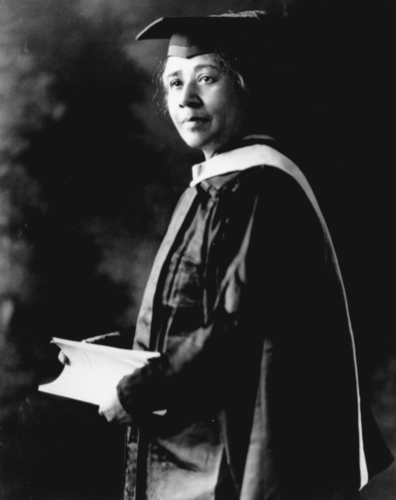
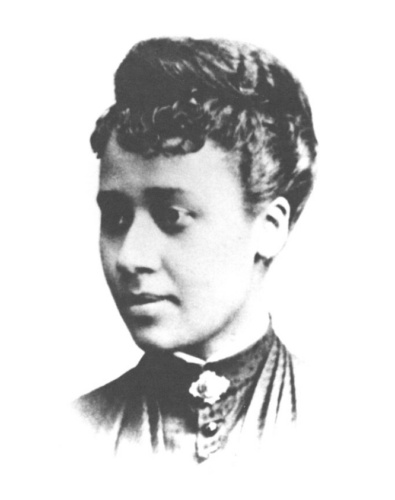
Born into slavery in 1858, Anna Julia Cooper's life forged a remarkable trajectory as she fought for race and gender equality with tenacity and unwavering determination. As a child, she attended the St. Augustine Normal School and Collegiate Institute in Raleigh, NC, where by the age of eight her math and language abilities earned her the position of student teacher; by eleven, she was paid a small tutoring stipend. She went on to earn a Master's Degree in Mathematics from Oberlin College in Ohio.
Though she did not have biological children, following the death of her brother she became the legal guardian of her five nieces and nephews. At the age of 56 she took them in and raised them as her own. In 1925 she earned a Ph.D. from the Sorbonne in Paris, defending her thesis entirely in French. She was the fourth African American woman to earn a doctoral degree. Cooper's life spanned 105 years from the last days of slavery to the heart of the Civil Rights Movement in the 1960's. She was an activist who fought for civil rights for her fellow African Americans, equality for women, and the poor. She is best known for her educational leadership, her challenges to the racist notion that African Americans were naturally inferior, and her groundbreaking collection of essays and speeches, A Voice from the South by a Black Woman of the South (1892).
In 1932, at the age of 74, Anna Julia Cooper completed "The Negro College Graduates Survey" from Oberlin College, her alma mater. The following pages contain excerpts from that survey and provide a window into her extraordinary intelligence, faith, and accomplishments. They also reveal her honest and at times disarmingly direct character, and that she epitomized St. Paul's counsel to "speak the truth in love."
The Negro College Graduates Survey
When did you decide on your vocation as an educator?
Not far from the kindergarten age I decided upon my career. Teaching has always seemed to me the noblest of callings, and the need to help the neglected presents a stronger appeal than money.
What do you believe to be your most outstanding accomplishment?
Perhaps others will think first of the defense of my Ph.D. thesis in French at The Sorbonne as being my most outstanding accomplishment. However, my own preference is the building of a beautiful home at the Capital from my own unsubsidized earnings to be dedicated in the name of my slave mother to the education of colored working people.
What motives prompted you to go to school?
It was innate and indomitable "wanting to know."
About her early life:
Like my mother, I was born in Raleigh, North Carolina. I do not know my biological father's birthplace. I really owe nothing to my White father beyond the initial act of procreation*. It is my mother that I give the highest praise and undying gratitude because she sacrificed to give me the advantages she never enjoyed. I had two brothers, Rufus and Andrew Haywood, both of whom were musicians. Rufus who died in 1882 was a North Carolina orchestra leader as well as the leader of Stanley's Band. In addition to his musical talents, my brother Andrew was an organizer of the state militia and a major in the Spanish-American War of 1898. I had no sisters. I got married at the age of 17 only to be widowed two years later. My husband, George Cooper, was an educated and ordained Episcopal priest. I had no biological children.
*It is widely assumed that Anna Julia Cooper's father was the owner of the plantation in Raleigh where she was born.
About her college studies:
I do not recall any subject that I did not thoroughly enjoy. Four professors gave me letters ranking me first in the class. My academic major at Oberlin was mathematics. I took all the courses offered in mathematics and taught advanced algebra in the Oberlin Academy. This demonstrated my ability and that my teaching was acceptable, even for White students.
About her motivation to become an educator:
I feel the vocation for which I was prepared was the education of neglected people.
About her life and work in Washington, D.C.:
I have been involved in some aspect of education for nearly fifty years. We are living in a country that is still very segregated in terms of race, gender, and class. As a result, most of my energy has been to be involved in activities that will uplift the Black race and encourage our youth to continue to study and learn. I believe very strongly that we have a responsibility to prepare our race to be able to work and give service to those who are less fortunate.
About her biggest disappointment:
Without question, my biggest disappointment was being released from the M Street/ Dunbar High School. While serving as principal of M Street High School, as the colored principal, I was under the supervision of the White Director of High Schools. At a meeting of principals, I was told when the question of scholarships in colleges came up, that the M Street graduates were not eligible to try for them. The Director at the same time recommended to the US Congress that a different curriculum be granted the colored High School, whose pupils he said were not capable of doing the regular work. As the principal, I was considered to be insubordinate for sending students from the M Street School to Harvard, Yale, Brown, and Oberlin. These were students directly from the M Street School classes who successfully passed their entrance exams; some with high honors. This was the first time in its history that the Colored High School of Washington, D.C. was listed as "accredited" by Harvard and given the certificate privilege. For this unpardonable "sin" against racial supremacy I, the Colored principal, suffer to this day the punishment of the damned from both the White maskers as well as the Colored understrappers and assistants.
About her racial philosophy:
My "racial philosophy" is not far removed from my general philosophy of life that the greatest happiness comes from altruistic service and this is in reach of all of whatever race and/ or conditions. The "Service" here meant is not a pious idea of being used; any sort of exploitation whether active or passive is to my mind hateful. Nor is the "Happiness" a mere bit of Pollyanna stuff. The extent, then, of the optimism in my philosophy is that the solution of our problem will be carried out by individuals, not en masse.
About education for Black students:
I have always stood for Education that aims at the making of Men rather than the constructing of machines. If the Negro is a man, then what is good for man, in all its ageold and infinite varieties, is good for the Negro. Why should he be cabined and cribbed with just this or just that for his mental pabulum-nourishment? If the post war machines method of tests and measurements "tossing out the unfit" prevails, we never can tell what is to be done for the untalented plodder who continues to want more.
About her faith:
I entered Oberlin as a bigoted "Churchwoman." Although I continued to attend the little Episcopal Church religiously, the breadth and the real universal appeal and outreach came from the Oberlin spirit. It was friendly contacts and the wider exposure through studying that had the inevitable result which I consider to be the humanizing of one's "churchianity," that is, the habits and teaching of good will. Also, the music, sermons, and the spirit of brotherhood were school influences that were most important in giving direction to my life.
"Religion must be life made true."
About her primary aim in life:
Also, I may say honestly and truthfully that my one aim is and has always been, so far as I may, to hold a torch for the children of a group too long exploited and too frequently disparaged in its struggling for the light. I have not made capital of my race, have paid my own way and have never asked a concession or claimed a gratuity. Nor on the other hand have I ever denied full identification in every handicap and every limitation that the checkered history of our native land imposes. In the simple words of the Master, spoken for another nameless one, my humble career may be summed up to date:-"She hath done what she could."
About what she is doing "now":
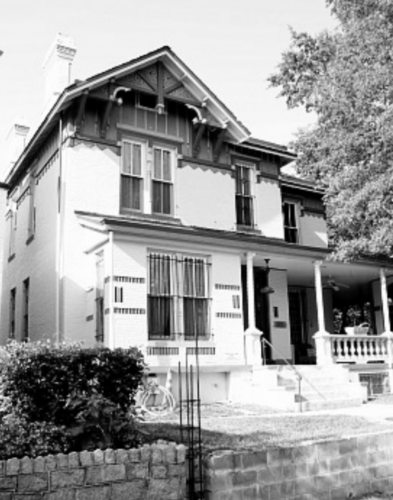
I am called President of Frelinghuysen University. The school has now for the first time a permanent location in my home at 201 "T" Street N.W. The curriculum includes a group of Schools for Adult Education, comprising a law school, school of religion, and opportunity classes for preacademic workers.
Final thoughts about her life:
To me life has meant a big opportunity and I am thankful that my work has always been the sort that beckoned me on, leaving no room for blasé philosophizing and rebellious resentment and with just enough opposition to give zest to the struggle, just enough hope of scoring somewhere among the winners to keep my head "unbowed tho bloody." While I suffer, I will not be defeated by the struggle.
"The best and most economical education is that which gives to the individual, according to his capacity, the training of “head, hand, and heart,” or, more literally, of mind, body and spirit which converts him into a beneficent force in the service of the world."



* Excerpts from Anna Julia Cooper's responses to The Negro College Graduates Survey, 1932
"When all the weak have received their due consideration, then woman will have her rights, and the Indian will have his rights, and the Negro will have his rights, and all the strong will have learned at last to deal justly, to love mercy, and to walk humbly; and our fair land will have been taught the secret of universal courtesy which is after all nothing but the art, the science, and the religion of regarding one's neighbor as one's self, and to do for him as we would, were conditions swapped, that he do for us."
- Anna Julia Cooper
Anna Julia Cooper’s Lasting Legacy
The U.S. Passport design unveiled in 2007, nicknamed “American Icon,” includes a quote from Anna Julia Cooper. She is the only woman among thirteen famous Americans quoted throughout its pages. Her quote appears alongside the Statue of Liberty.
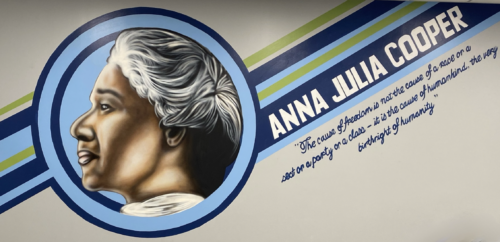
“The cause of freedom is not the cause ofrace or a sect, a party or class -- it is the causeof mankind, the very birthright of humanity.”

On June 8th 2009, our Founding Board voted to name the School after Anna Julia Cooper. Coincidentally, three days later the United States Postal Service issued a commemorative stamp in her honor.

Her legacy lives on here at AJC, through students striving to reach their full potential -- and through those who educate and uplift them along the way. We embrace the opportunity to follow in the footsteps of our namesake in this challenging and life-changing work.
"Our money, our schools, our governments, our free institutions, our systems of religion and forms of creeds are all first and last to be judged by this standard: what sort of men and women do they grow?"